
In brief: ISO 27001 certification is decided in an audit that an accredited certification body carries out in two stages. Surveillance audits follow every year, and the certificate has to be renewed after three years. This article explains what happens at each stage, what the auditor looks for and what your organisation needs to have ready.
ISO 27001 sets the requirements for your organisation. The audit itself is governed by a different standard, ISO/IEC 17021-1, which certification bodies have to follow. ISO/IEC 27006-1 adds requirements specific to information security.
The main steps are therefore the same whichever certification body you choose. Deadlines and practical details vary, and you agree those with the body.
Who carries out an ISO 27001 audit?
An accredited certification body carries out the audit. It is independent of both you and your adviser, and it invoices you directly for the audit.
Accreditation means that an independent third party has assessed the certification body’s competence, integrity and independence. A national accreditation body makes that assessment. In the United Kingdom it is the United Kingdom Accreditation Service (UKAS), which is appointed by the UK government. In Norway it is Norwegian Accreditation (Norsk akkreditering, page in Norwegian).
Both accredit bodies that certify management systems against ISO/IEC 17021-1. UKAS also lists ISO/IEC 27006-1 as the standard for bodies that certify to ISO 27001.
Before you sign with a certification body, check its accreditation and what the accreditation covers. UKAS publishes a directory of accredited organisations, and Norwegian Accreditation has its own register. The UKAS service CertCheck also lets you check whether a management system certificate is valid.
Secured by FM CyberSecurity works the same way. We build the management system and the documentation together with you. For the audit we use UKAS-accredited certification bodies based in the UK, and the body carries out the audit and sends its invoice to you.
What happens in stage 1?
In stage 1 the auditor reviews your documentation and assesses whether you are ready for stage 2. You receive written conclusions, which also point out anything that could become a nonconformity later.
Under ISO/IEC 17021-1, the auditor uses stage 1 to
- review the documented information in the management system
- establish the scope, including sites, processes and legal requirements
- talk to your people to judge how prepared the organisation is
- check that internal audits and management reviews are planned and carried out
- agree the details of stage 2
Stage 1 covers more than a document check. The auditor uses it to understand the organisation and to plan what stage 2 will examine.
The interval between the stages has to allow you time to resolve what the auditor has raised. The standard also says that the results of stage 1 can lead to stage 2 being postponed.
What happens in stage 2?
In stage 2 the auditor evaluates whether the management system has been implemented and whether it is effective. This is the certification audit proper, and it covers every requirement in ISO 27001.
The auditor gathers information through interviews, by observing how work is done, and by reviewing documents and records. The audit covers, among other things,
- evidence that the requirements of the standard are met
- how you measure and follow up your security objectives
- how legal requirements and customer contract requirements are handled
- whether day-to-day control of your processes works
- the internal audit and the management review
- management’s responsibility for the policies
The auditor works by sampling. A procedure that has been written and never used will show when the auditor asks for examples from recent months.
You receive a written report after the audit. The auditor may identify opportunities for improvement, and is not allowed to recommend specific solutions.
What happens if the auditor finds nonconformities?
A nonconformity means that a requirement is not met. Nonconformities are common, and they do not stop certification as long as you deal with them within the time the certification body sets.
ISO/IEC 17021-1 defines two kinds. A major nonconformity affects the ability of the management system to achieve its intended results. A minor nonconformity does not, although several minor ones against the same requirement can together amount to a major one.
For each nonconformity you have to analyse the cause and describe both the correction and the corrective action, meaning what will stop the problem from coming back.
The two kinds are treated differently before the certification decision. Major nonconformities must be corrected, and the certification body must have verified the actions. For minor nonconformities, the body must have accepted your plan.
The certification body sets the deadlines. The standard adds an outer limit. If a major nonconformity has not been verified as closed within six months of the last day of stage 2, stage 2 has to be carried out again.
When do you get the certificate?
The certificate is issued after the certification decision, which comes some time after the audit has finished. The decision is made by people other than those who carried out the audit.
The audit team sends its report, its comments on the nonconformities and a recommendation to the certification body. The body reviews the material before it decides whether to grant certification.
Tenix shows how the dates can fall. The Norwegian company’s software manages charging for more than 2,000 electric buses in six countries, and it did its ISO 27001 work with Secured by FM CyberSecurity. In June, less than two months after the work began, the auditor had reviewed and approved the work. The certificate was issued in August, after the summer holidays.
If you need the certificate for a tender deadline, plan towards the date the certificate is issued. Our article on how long ISO 27001 takes covers the planning, and you can read the Tenix story in full.
What is a surveillance audit?
A surveillance audit is a smaller audit that checks that the management system is still being followed between certifications. It takes place at least once every calendar year.
Under ISO/IEC 17021-1, certification runs in three-year cycles, and the first cycle starts with the certification decision. A cycle consists of surveillance audits in the first and second years and a recertification audit in the third, before the certificate expires.
The first surveillance audit has to take place no more than twelve months after the certification decision. The auditor does not necessarily examine the whole system, but some items are always included:
- internal audits and the management review
- the actions taken on nonconformities from the previous audit
- complaints handling
- whether the management system is achieving its objectives
- progress on planned improvements
- changes to the organisation and the system
- how you refer to the certification and use the mark
A certificate can be suspended. That happens, for example, when the management system persistently or seriously fails to meet the requirements, or when the organisation does not allow surveillance audits to be carried out.
How does recertification work?
In the third year the certification body carries out a recertification audit, which assesses the whole management system again. It has to be completed before the certificate expires.
The auditor reviews the surveillance audit reports and considers how the system has performed over the whole cycle. If the organisation or the system has changed significantly, the recertification may also include a stage 1.
Major nonconformities must be corrected and verified before the expiry date. Otherwise the certificate is not extended. Schedule the recertification audit well ahead of the expiry date, so that you have time to close nonconformities.
If the certificate has expired, the certification body can restore it within six months, provided the outstanding activities are completed. After that, at least a new stage 2 is required.
What do you need to have ready before the audit?
You need to be able to show a management system that has been in use for a while, with evidence from daily operations. Documents alone will not carry the audit.
Before stage 1, have these in place:
- a justified scope that shows which services, sites and systems the certificate will cover
- the risk assessment and the plan for treating the risks
- the Statement of Applicability (SoA), which shows which controls apply and why
- policies and procedures that describe what your people actually do
- a completed internal audit with documented findings and actions
- minutes from the management review
- evidence that the controls are in use, such as access decisions, supplier assessments and recovery exercises
Set aside time for your people as well. The auditor will want to talk to management and to those who carry out the controls, and they should be able to explain their own responsibilities in their own words.
Our ISO 27001 checklist shows how to build this up step by step.
Who can you contact?
Johan Vorgaard leads compliance and ISO 27001 at FM CyberSecurity, and he led the compliance work for Tenix. He can help you assess how ready you are for stage 1, carry out the internal audit and prepare the management review. You can reach him at [email protected].
We offer ISO 27001 as a gap analysis, as a project or as part of Secured by FM CyberSecurity. Secured comes with the ISO 27001 Guarantee. Become certification ready in a couple of weeks. If you do not pass the audit within the agreed time, we cover the next attempt, unless your organisation has acted with gross negligence.
What the work costs depends on size, complexity and tools. We go through that in a meeting.
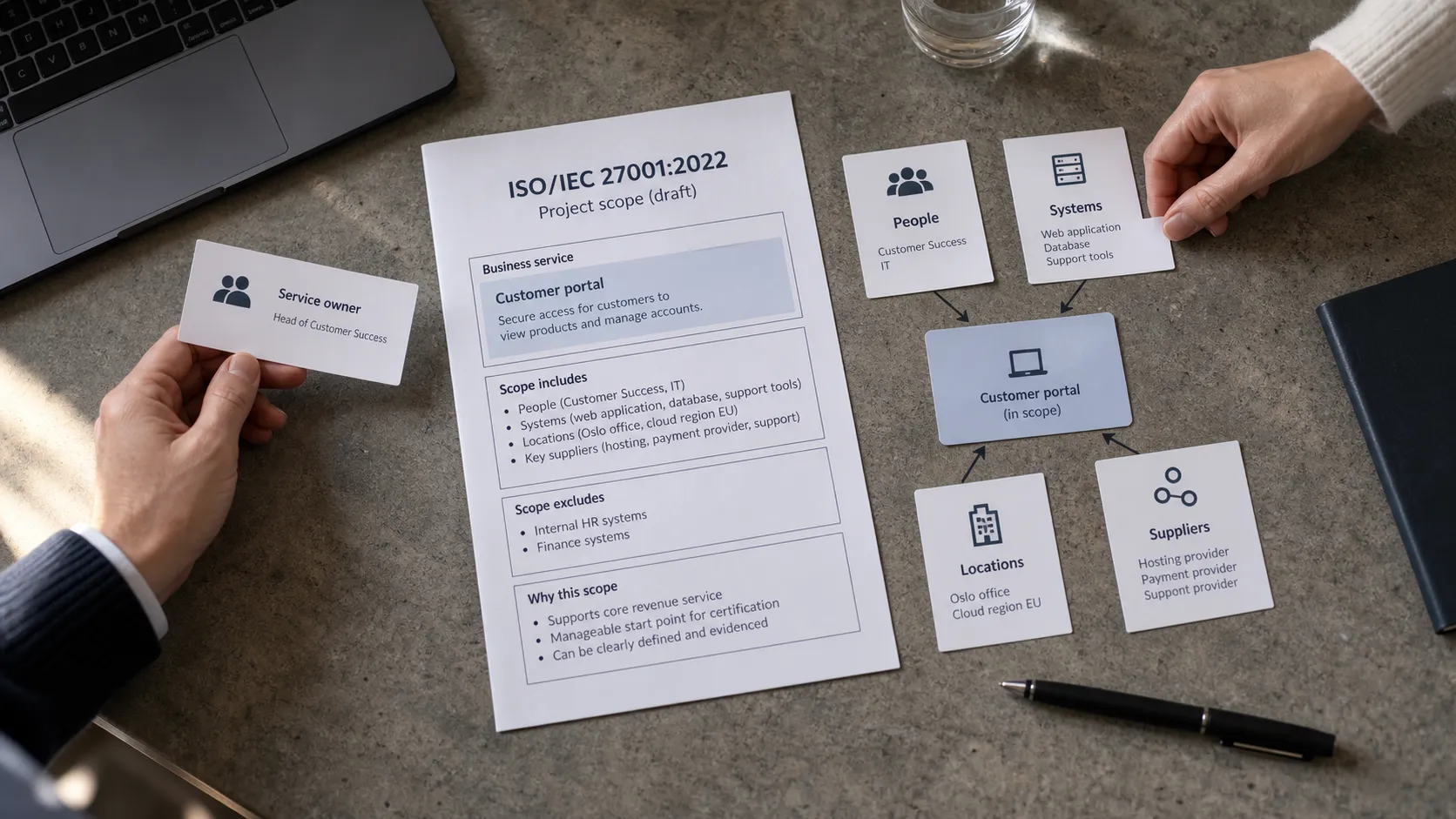
The cover image is an AI-generated editorial illustration. Screens and documents are illustrative concepts.