What is CrowdStrike Falcon Guardian?
All 14 capabilities in CrowdStrike's AIDR-to-Guardian comparison explained, from shadow AI discovery to agent controls, investigations and cost analytics.

In brief: Falcon Guardian is CrowdStrike’s security product for understanding and controlling AI use in a business. It combines discovery of AI tools and agents with protection for sensitive data and detection of threats involving AI. CrowdStrike’s Guardian data sheet overview
CrowdStrike is the cybersecurity company behind the Falcon platform. Guardian builds on its earlier Falcon AI Detection and Response product, known as AIDR, and adds deeper visibility into the actions AI agents perform on computers. CrowdStrike’s explanation of Guardian
An AI agent can work with files, run commands and use applications, depending on its access. Guardian addresses the resulting security questions: which agents are operating, what are they doing, and which activities should be stopped? Guardian’s launch announcement
The complete AIDR-to-Guardian feature list
CrowdStrike’s Falcon Guardian Pitch Deck, page 19, compares 14 named capabilities. Four are marked for both Falcon AIDR and Guardian; ten additional rows are marked for Guardian. The table below preserves every row and explains its purpose.
“Listed” means the slide marks the capability for that product. A dash means the AIDR column is blank on the slide. This is CrowdStrike’s product comparison, not an independent test.
| Capability | AIDR | Guardian | What it covers |
|---|---|---|---|
| Shadow AI discovery | Listed | Listed | Finding AI use outside the organisation’s approval or oversight. |
| AI governance & policy enforcement | Listed | Listed | Applying rules to how people and applications use AI. |
| Prompt & LLM response threat detection | Listed | Listed | Inspecting instructions and model responses for threats. |
| Workforce AI & enterprise-developed AI security | Listed | Listed | Protection for employees’ AI use and AI applications built by the business. |
| Continuous endpoint agent discovery | — | Listed | Finding AI agents running on managed computers on an ongoing basis. |
| Agent inventory & risk scoring | — | Listed | An agent inventory with risk information to support investigation. |
| Runtime AI visibility | — | Listed | Seeing activity while agents operate. |
| Agent graph & prompt-to-process visibility | — | Listed | Connecting a request, agent actions, tool use and downstream processes. |
| Agentic blast radius analysis | — | Listed | Examining the reach and potential impact of agent activity. |
| Runtime agent controls | — | Listed | Controls over supported agents and their activity while they run. |
| Agent IOA detection | — | Listed | Detecting indicators of attack in agent behaviour. |
| Malicious skill detection | — | Listed | Detecting malicious skills that extend or direct an agent’s behaviour. |
| Falcon MCP investigations | — | Listed | Using Falcon’s Model Context Protocol integration in investigations. |
| Agent token usage & cost analytics | — | Listed | Analysing agents’ model consumption and associated costs. |
Source: CrowdStrike, Falcon Guardian Pitch Deck, page 19. The slide ends with “And more”; these are all 14 named rows, rather than a claim to list every feature in the platform. The public Guardian description provides the broader product context.
Visibility into AI use, risk and cost
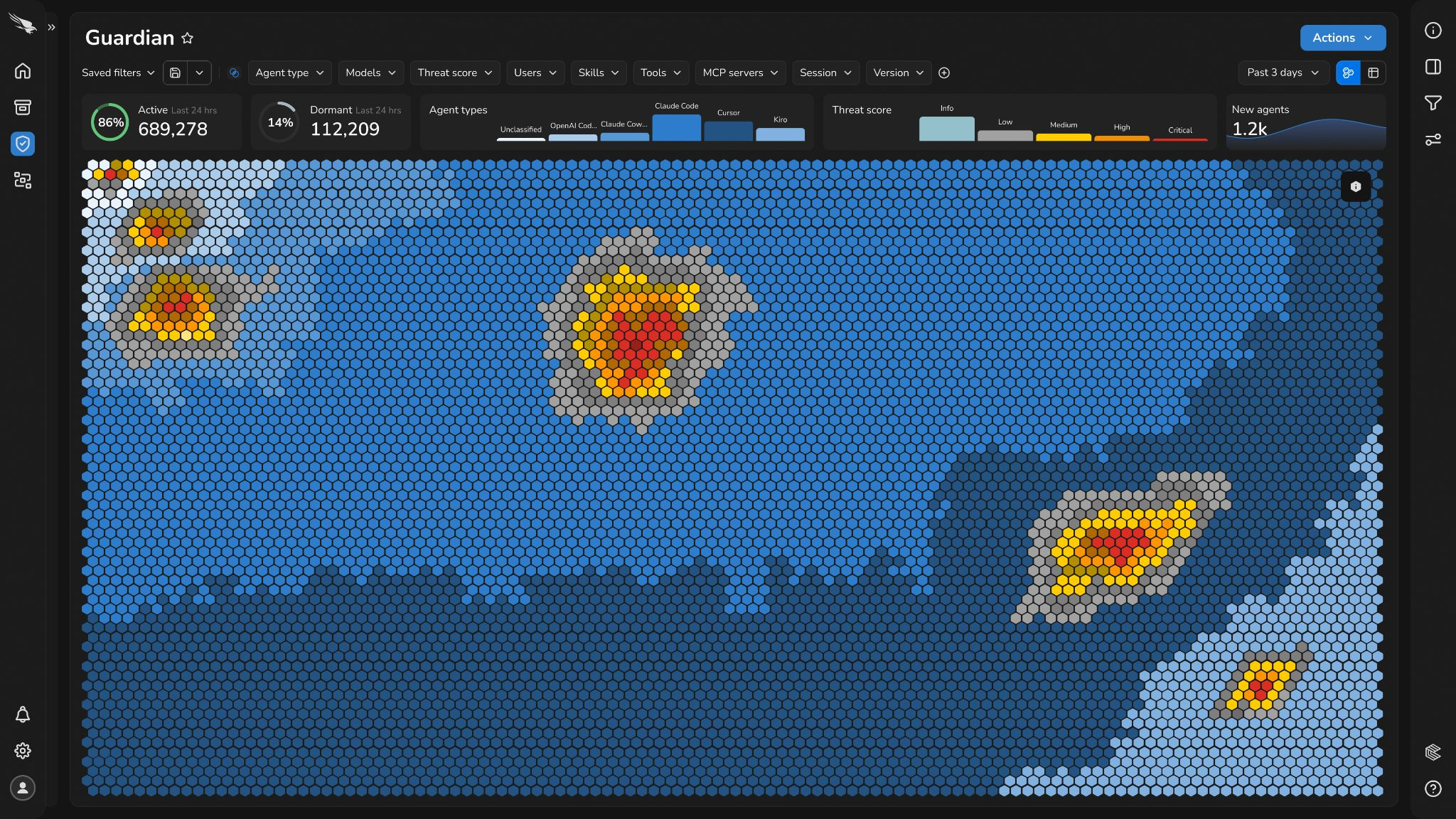
Guardian can reveal AI tools and agents used by employees, including shadow AI: use outside the company’s approval or oversight. CrowdStrike describes visibility into which tools are in use, who uses them and their token consumption. AI discovery in Guardian
The comparison explicitly includes cost analytics alongside token usage. Tokens measure the input and output processed by a model; Guardian’s developer documentation describes model names and input/output token counts for recorded agent process executions. Cost analysis adds a financial view of that consumption, but neither the slide nor those token fields establish a hard spending cap or a complete supplier invoice. Guardian’s token-usage documentation
Controls for agents and AI websites
Guardian lets an organisation define which supported types of AI agent may run on its managed computers. An agent type that has not been approved can be blocked. This controls the agent application; it is distinct from choosing which underlying AI model an application may use. Guardian’s agent access controls
The AIDR browser controls provide another form of restriction: rules can block access to monitored websites or redirect the user elsewhere. This capability requires the supported CrowdStrike-hosted browser extension. It is a browser access control, rather than a universal block on every way of reaching an AI service. Site access documentation
Protection for prompts and company data
Guardian also retains AIDR’s protection for AI interactions. The AIDR documentation describes inspection of prompts and responses for risks, including malicious instructions and sensitive information. It supports rules that report a finding, modify detected content, or mark a request for blocking. AIDR’s detection and response capabilities
One relevant threat is prompt injection: instructions embedded in material an AI system receives that try to redirect its behaviour. A hypothetical example is a document telling an assistant to send company information elsewhere while the assistant is supposed to summarise it.
Policies determine which checks apply and how the system responds. The integration handling the interaction must support the chosen action; a logged detection does not necessarily mean the request was stopped. How AIDR policies work
Connecting a request to what the agent does
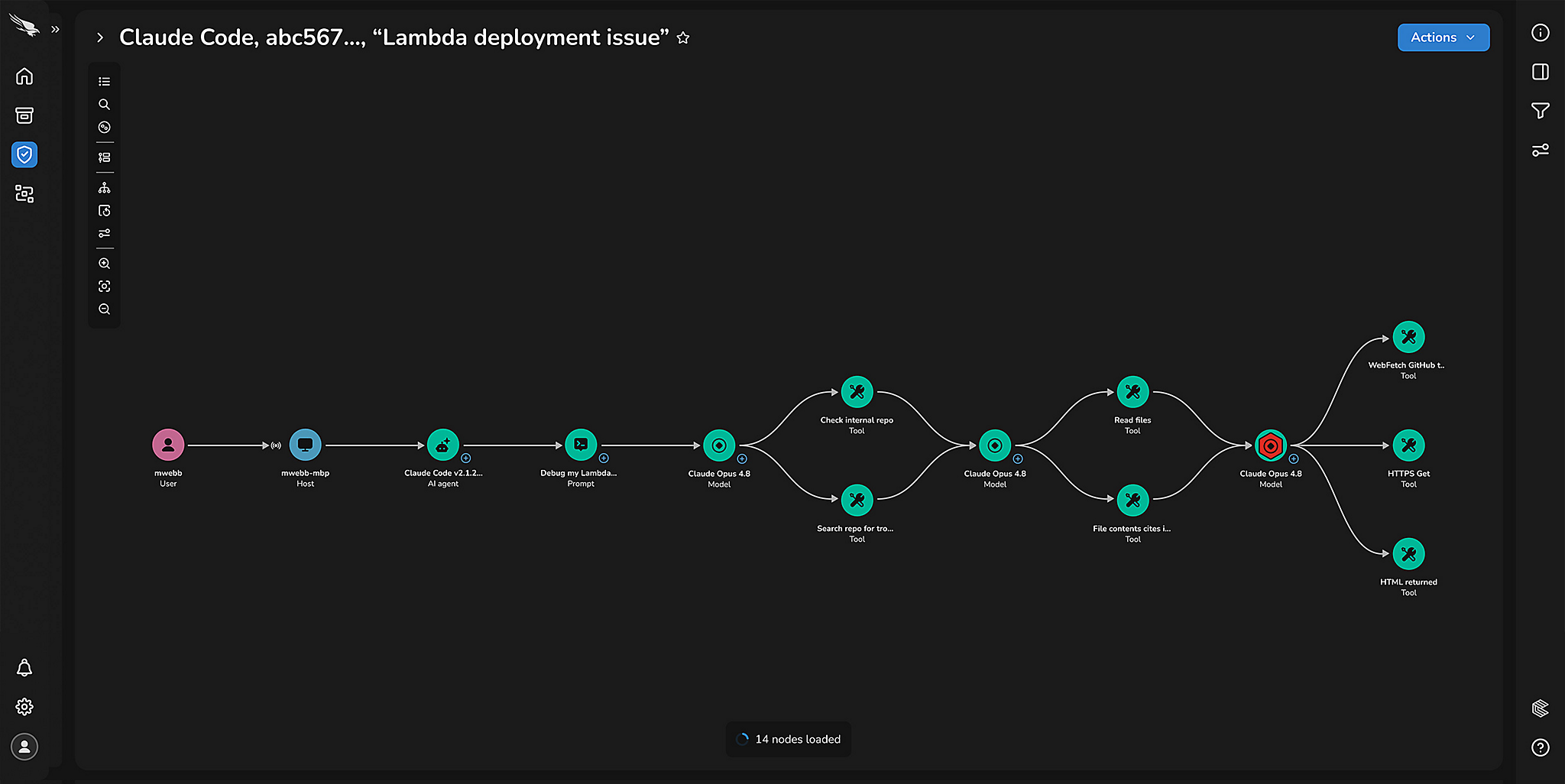
Guardian connects supported agents’ activity with Falcon’s records of activity on the computer. That gives an investigation context beyond the conversation: the user’s request, the tools the agent invoked and the system actions that followed. CrowdStrike describes this as runtime protection, meaning protection while the agent is operating. Guardian’s agent investigation capabilities
The slide’s additional investigation features describe several ways to inspect that activity. An agent graph connects events; blast-radius analysis examines how far their effects can reach. IOA means indicator of attack: behaviour that signals a possible attack. Malicious skill detection concerns skills that supply an agent with instructions or capabilities. These descriptions explain the named functions; they do not mean every detection automatically blocks an action.
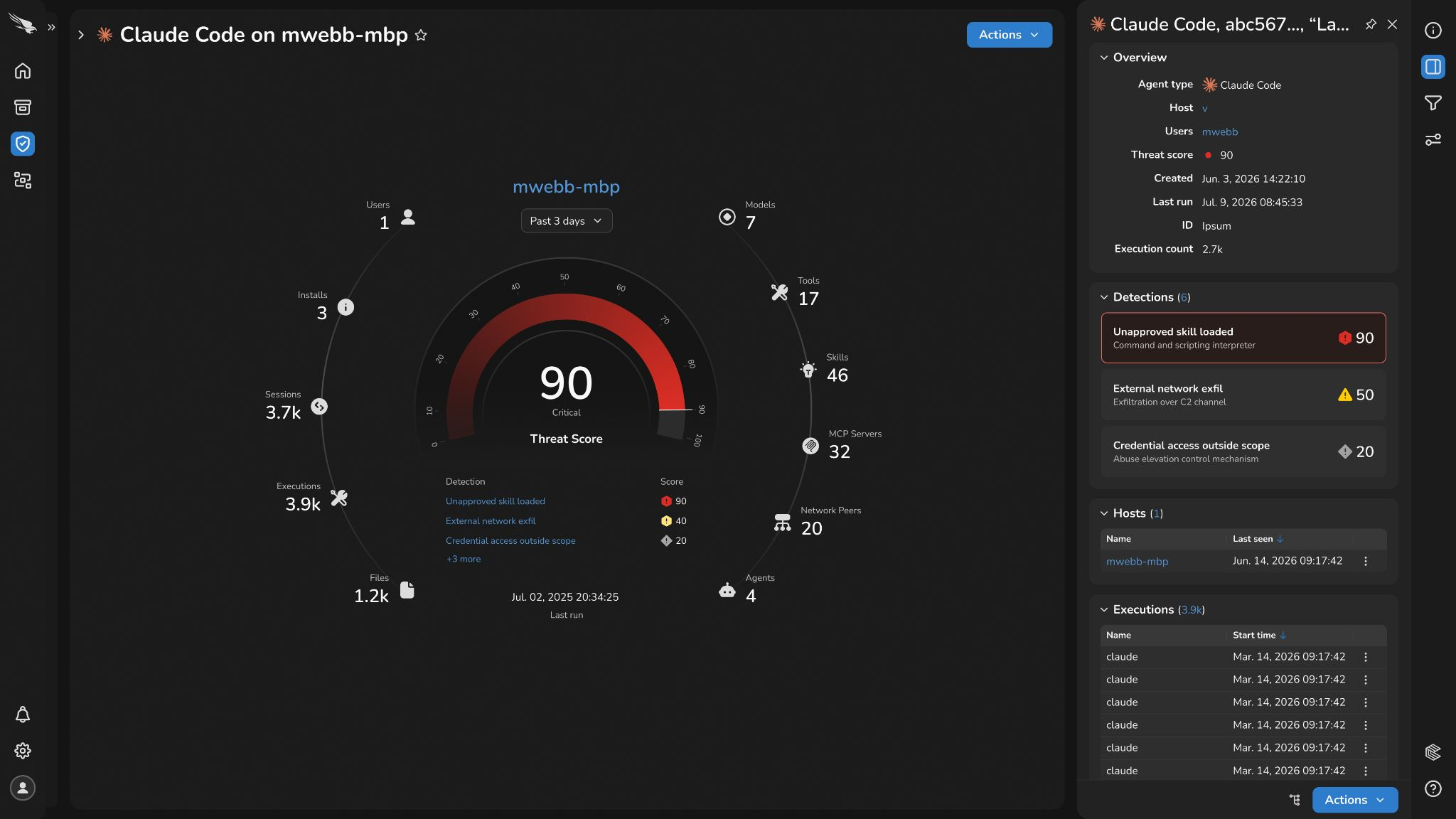
MCP, or Model Context Protocol, lets an AI client access tools and context through an integration. In Falcon’s documented Guardian module, investigation tools can query agent executions and related information. The feature is an investigation interface, not a separate AI model. Falcon MCP Guardian documentation
How the different protections are connected
Coverage comes from the integrations deployed around the AI workflow. CrowdStrike calls these collectors. They include browser integrations, connections inside applications, supported gateways and agent integrations. Some can block or alter data during an interaction; others collect activity for analysis. For example, the documented cloud and OpenTelemetry collectors provide monitoring without blocking requests as they pass through. Collector capabilities and coverage
Guardian alongside SafeMind and Agentic IdP
Agentic Identity Provider addresses the identities and access behind agent actions. SafeMind uses offensive and defensive AI to perform security work. Our Fal.Con Las Vegas roundup explains how those announcements sit alongside Guardian’s protection of AI activity.