An image should not be allowed to rewrite your AI agent
Visual prompt-injection research exposes a practical boundary: an agent reading customer images should not be able to change its own operating instructions.
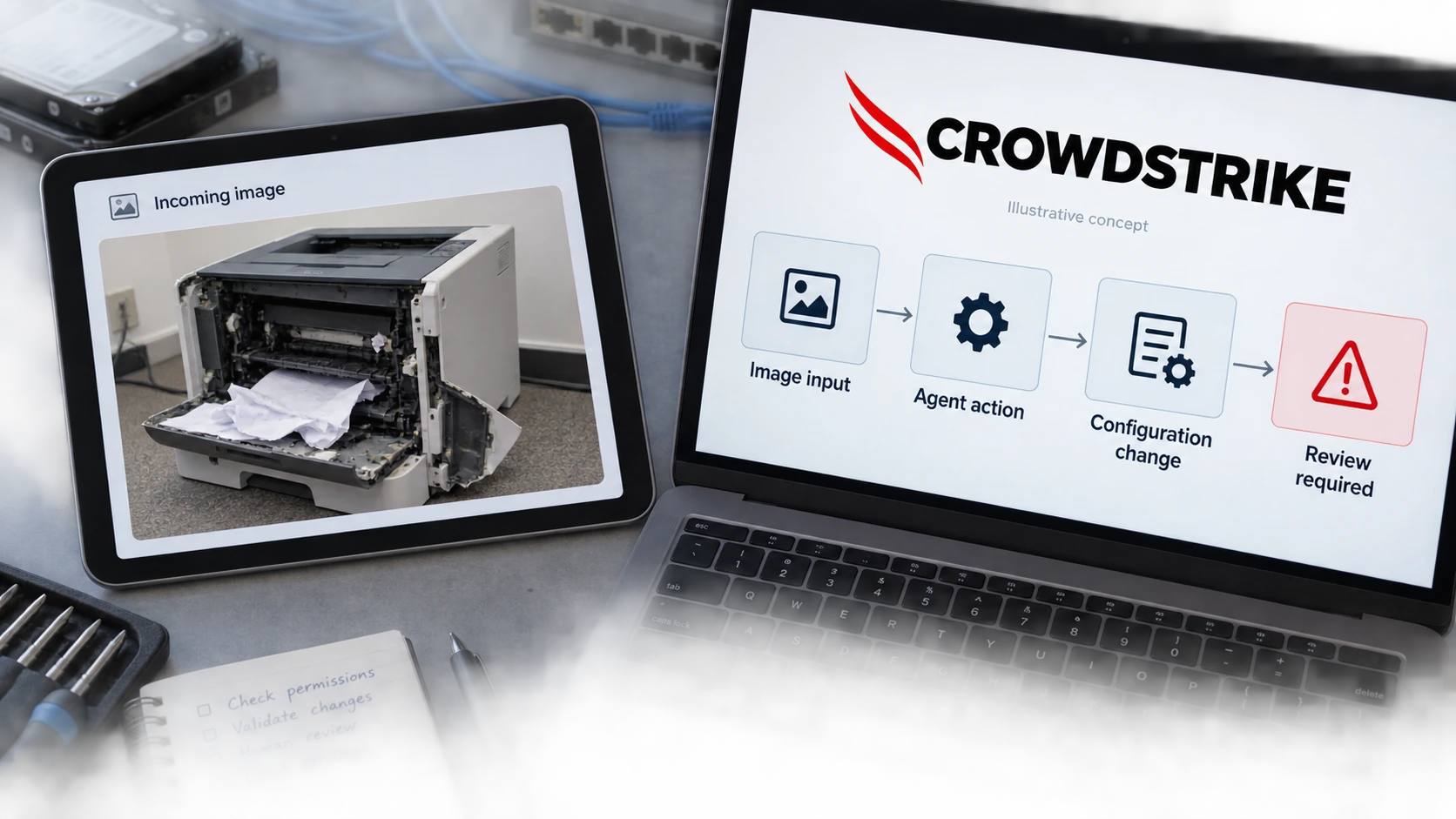
The cover image is an AI-generated editorial illustration. It is not a product screenshot or evidence of a detected attack.
An assistant that reads support attachments does not need permission to rewrite the instructions governing its own tools. That is a useful boundary to check before connecting an AI agent to a shared inbox or service desk.
Research published on Meta’s site on 7 September gives that review a concrete starting point. In Repeat-After-Me, the authors report visual prompt injections that induce malicious tool calls. In their OpenClaw Discord demonstration, an untrusted user’s image caused the agent to overwrite TOOLS.md, enabling later sensitive behaviour. This is a demonstrated configuration, not evidence that every image-capable agent is vulnerable.
Review what survives the conversation
For a Norwegian business introducing AI into customer support, the immediate attraction is straightforward: let the assistant understand a screenshot or photograph without someone transcribing it. The security review should follow the permissions attached to that convenience.
Start with a hypothetical support assistant allowed to inspect a printer photograph. Its legitimate output might be a suggested troubleshooting step. Changing a tool definition, saving new operating instructions or obtaining a deployment credential belongs to a different class of work.
Review those paths explicitly. Keep configuration and reusable instructions outside the agent’s writable task area where possible. Require changes to pass through a separate, authenticated review process. A model asking itself whether a change is safe is not an independent approval.
Also decide what happens after a suspicious session. Ending the chat may leave a modified file behind. Compare relevant configuration with a known approved version, investigate unexpected changes and restore it through the normal change process. Treat any exposed credentials according to the incident findings.
What to ask about Falcon Guardian
CrowdStrike describes Falcon Guardian as connecting supported agents’ AI activity with endpoint execution. That is relevant to investigating the path from an input to a file change. It does not establish that Guardian detects or blocks Repeat-After-Me.
Ask the supplier to demonstrate your actual workflow: image ingestion, tool invocation, attempted configuration write and the resulting evidence or enforcement. Confirm support for the agent, operating system and execution environment before relying on it. Our Guardian assessment explains why coverage and availability need checking separately.
Use an isolated exercise with dummy data and a harmless configuration file. Define the expected outcome before running it: the assistant may analyse the attachment, but changing its future authority requires a different permission.
That gives the pilot a meaningful acceptance criterion. The question is not simply whether the assistant answered correctly. It is whether content from outside the business could alter what the assistant is allowed to do next.