SOC 2 compliance for Norwegian SMBs selling into the US
SOC 2 can win you a US deal or burn six figures you did not need. Here is how to tell which, and how it fits ISO 27001.
You can spend six figures chasing a SOC 2 report you do not need, or you can lose the one US deal that required it. Most Norwegian small firms guess wrong on this, in both directions.
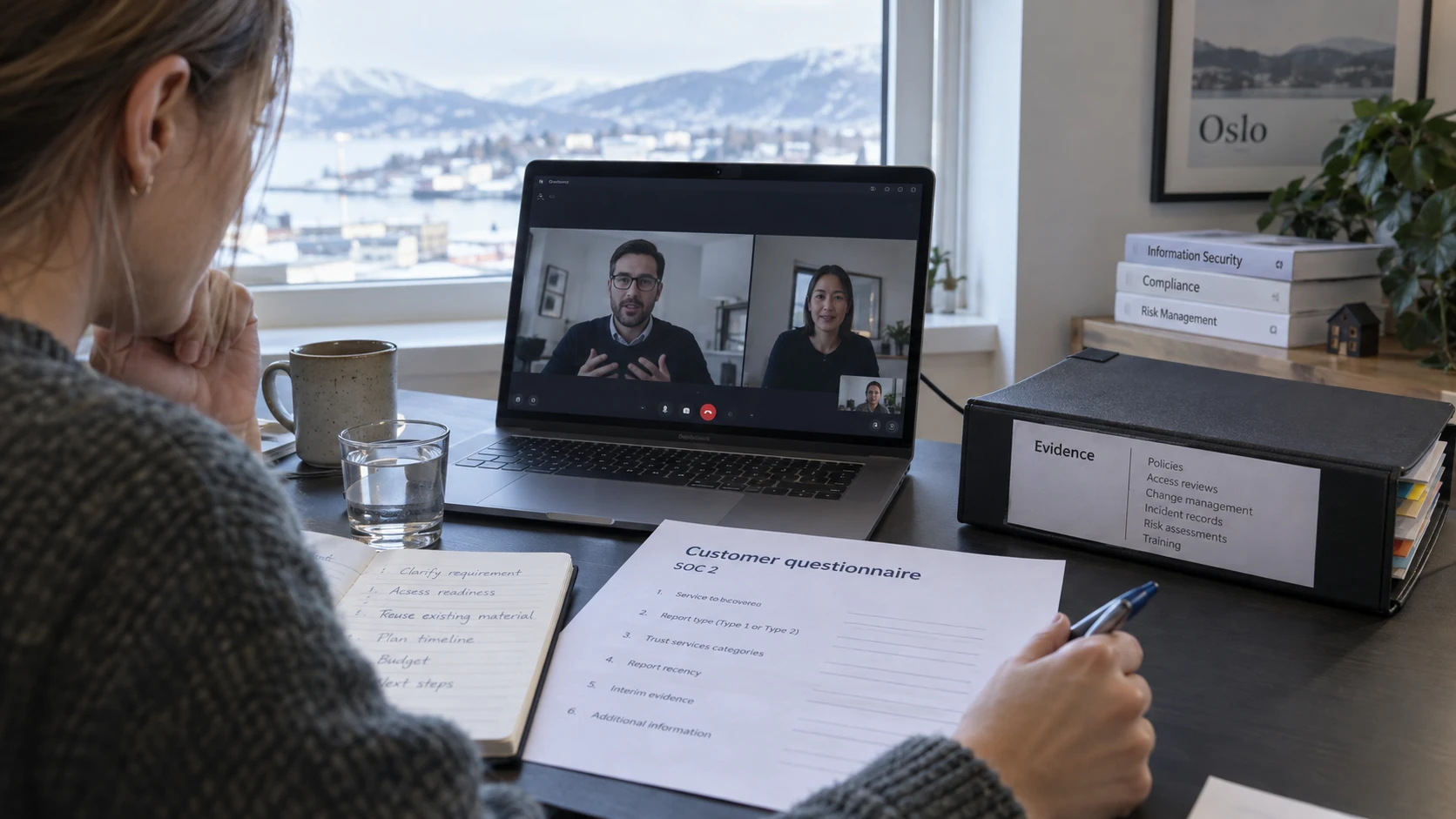
SOC 2 is a US audit report on how well a company protects customer data. A licensed accounting firm reviews your controls and writes an opinion. It is not a law. No Norwegian regulator asks for it. It exists because US buyers ask for it before they sign.
Across compliance scoping calls this year, I keep meeting two versions of the same firm. One has bought a full SOC 2 programme on a consultant’s advice, with no US customer in sight. The other has a signed-ready US contract stalled in procurement because the buyer wants a SOC 2 report the firm does not have. Both spent money in the wrong order.

The risk runs both ways
Over-investing and under-investing both cost real money, so treat SOC 2 as a sales decision, not a security badge.
Buy SOC 2 with no US buyer, and you carry an annual cost for a report nobody reads. Public 2026 guidance from audit and automation vendors puts a small-company engagement in the rough range of a few hundred thousand kroner once you add the auditor fee, tooling, and internal time, and it repeats every year (SOC2Auditors, 2026). Spend that with no buyer asking, and it is a cost with no return.
Skip it when a US enterprise needs it, and the deal stalls. US procurement teams are built around SOC 2. Their security reviewers know how to read the report and their vendor questionnaires ask for it by name (Secureframe, 2026). No report, no signature, however good your security really is.
What the market asks for
US buyers tend to ask for SOC 2; Norwegian and other European buyers tend to ask for ISO 27001. The credential follows the customer’s home market, not your security level.
ISO 27001 is the international standard for an information security management system. A certification body audits you and issues a certificate the rest of the world recognises. It is the proof most Norwegian and EU buyers accept, and EU rules like NIS2 are pushing demand for it higher across European supply chains (Privalex, 2026).
SOC 2 is the US norm, mostly in technology, software-as-a-service, and financial services. The split is geographic. If your customers sit in Oslo, Stockholm, and Munich, they want the ISO certificate. If your growth plan points at New York and San Francisco, you will hit SOC 2 requests (HST Solutions, 2026).
The good news for a firm doing both: the two frameworks share most of their controls. Industry guidance in 2026 puts the overlap around 70 percent, so once one is in place, adding the second is weeks of focused work rather than a fresh build from zero (Truvo, 2026). You write the access policy and the incident plan once, and both reports lean on the same evidence.
One more distinction worth knowing. SOC 2 comes in two depths. A Type 1 report checks your controls on a single day. A Type 2 report checks they ran correctly over months, and that is the one most US buyers want. We cover what that difference means in detail in our piece on what SOC 2 Type 2 is and why US customers ask for it, so we will not repeat the internals here.
The decision the board owns
The board has one call to make: pursue SOC 2 now, defer it, or lead with ISO 27001 and add SOC 2 only when a US deal demands it.
For most Norwegian small firms, the third path is the cheaper one. Lead with ISO 27001 because your home market recognises it. Build the controls and the evidence well. When a US deal appears and the buyer asks for SOC 2, you are most of the way there already, and the gap is a short add-on rather than a standing start.
Pursue SOC 2 first only when you have a named US opportunity, or a clear US pipeline, that asks for it. A signed-ready contract waiting on the report is the moment the spend pays for itself. A vague hope of selling to America one day is not.
Whichever way you go, FM CyberSecurity does not write the SOC 2 opinion. A licensed accounting firm issues that report; we are not the auditor. What we do is the readiness work and the overlap planning: mapping your existing controls against both frameworks so you build the evidence once and avoid paying twice for the same paperwork.
See FM CyberSecurity’s credentials and partner certifications at /partners/. Or book a 30-minute board-level conversation on whether SOC 2, ISO 27001, or both fit your sales plan.
FAQ
Do we need SOC 2 or ISO 27001?
It depends on where your buyers are. US enterprise customers usually ask for SOC 2; Norwegian and other European customers usually ask for ISO 27001 (HST Solutions, 2026). Pick the credential your real market asks for, not the one that sounds more impressive.
Can one project cover both SOC 2 and ISO 27001?
Largely, yes. The frameworks share roughly 70 percent of their controls, so most of the policies and evidence count toward both (Truvo, 2026). Plan them together and you build the shared parts once instead of twice.
How much does SOC 2 cost for a small firm?
Public 2026 vendor guidance puts a small-company SOC 2 programme in the rough range of a few hundred thousand kroner once you count the auditor fee, tooling, and internal time, and it recurs every year (SOC2Auditors, 2026). Your number depends on the scope and how ready your controls already are, so treat that as a planning figure, not a quote.
Does a Norwegian SMB ever legally need SOC 2?
No. SOC 2 is market-driven, not a legal requirement in Norway. No Norwegian or EU regulation mandates it. You need it when a customer’s contract or procurement process asks for it, which is a sales requirement, not a legal one.
Should we start with ISO 27001 and add SOC 2 later?
For most Norwegian small firms selling at home first, yes. Lead with the ISO certificate your market recognises, build the controls properly, then add SOC 2 as a short extension when a real US deal calls for it. The control overlap means the second framework is an add-on, not a restart.