GPT-5.6-Cyber expands access to advanced security research
OpenAI's cyber model responds to more advanced security requests. Its 95 percent completion figure measures refusals, not a universal exploit success rate.
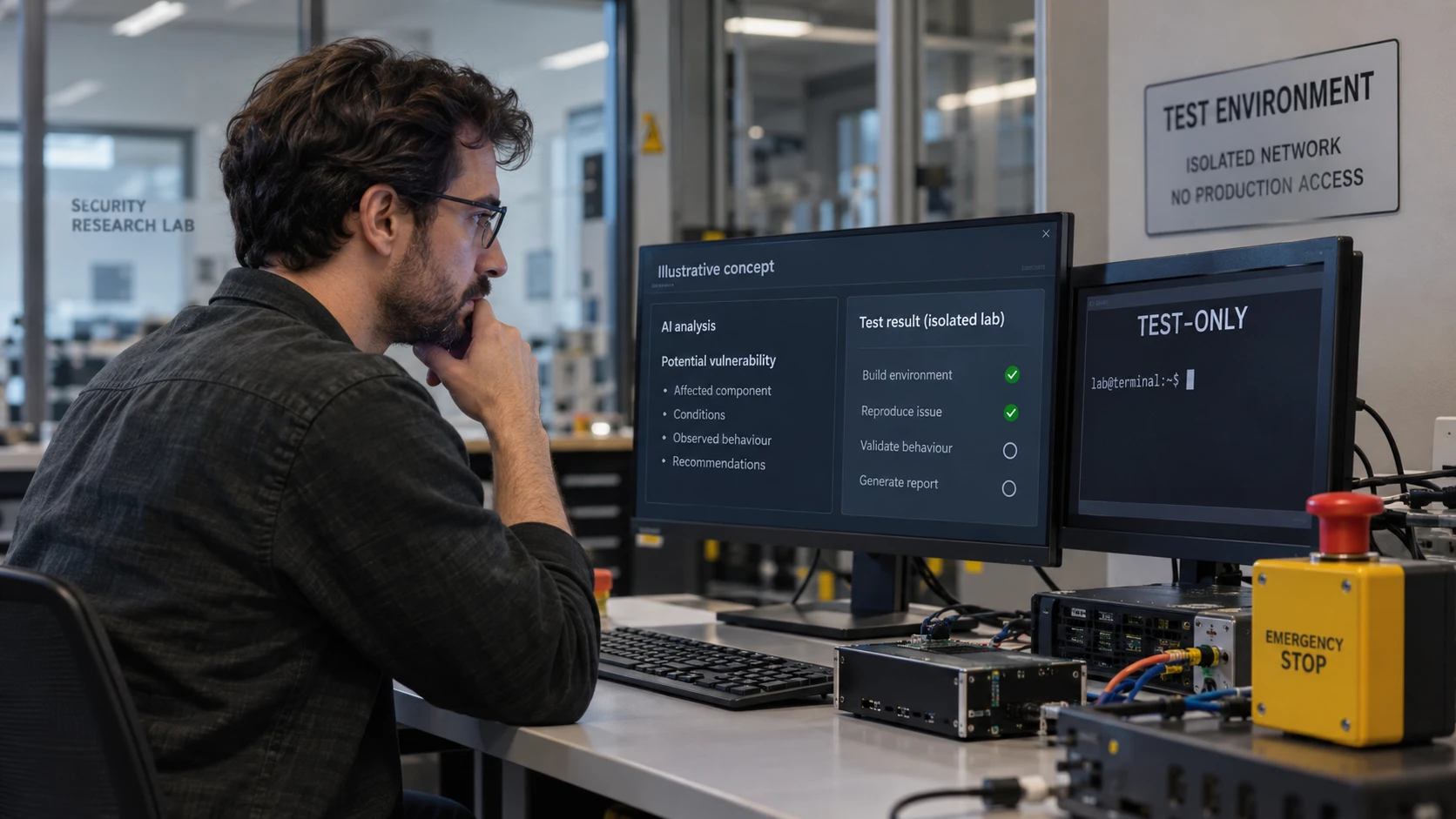
The cover image is an AI-generated editorial illustration. Screens and documents are illustrative concepts.
OpenAI introduced GPT-5.6-Cyber on August 10 through Daybreak Red, its access programme for approved security research. The model supports work such as vulnerability research and exploit development.
One number in the announcement needs careful reading. The reported 95 percent completion rate measures how often the model responds to advanced cybersecurity requests. It does not mean that 95 percent of attempted intrusions succeed. OpenAI reports working-exploit evaluations separately, and results vary by task and available reasoning budget.
That distinction matters when assessing both the threat and the value of a security tool. A model willing to produce an answer still has to produce a correct answer in the target environment.
Evaluate the result, not just the response
For defenders using AI-assisted research, ask for reproducible findings. A useful vulnerability report identifies the affected version, required access, observed behaviour and limits of the proof of concept. Generated code and confident explanations need validation before they become an emergency change request.
Run that validation within an explicitly authorised environment. Keep production credentials out of the workspace unless they are essential and tightly scoped. Define which systems the agent may contact and which actions need review. Approval to investigate an application should not silently become permission to probe its suppliers.
Patch priorities still need context
More capable research tools can increase pressure on remediation, but a benchmark does not establish one patch deadline for every system. Prioritise evidence of active exploitation, internet exposure, reachable attack paths and business impact.
For an exposed system with a relevant exploit, waiting for the next routine maintenance cycle may be inappropriate. If a patch cannot be deployed safely yet, document the temporary restriction or other mitigation, assign an owner and set a review date. Measure time to actual remediation rather than time to ticket creation.
Our explanation of AI hacking describes how AI agents can carry out intrusions. The immediate question for a security team is concrete: when a credible new finding arrives, can someone identify the affected systems and make a decision that day?